2025 (Reading) Year in Review

This year was rough. I went into it thinking that it couldn’t possibly be worse than 2024, but even though what made 2024 so difficult ended positively, 2025 completely unraveled. I hit a wall. I had to make changes. And now, looking back, I’m impressed with how far I’ve come. My favorite books tell the story.

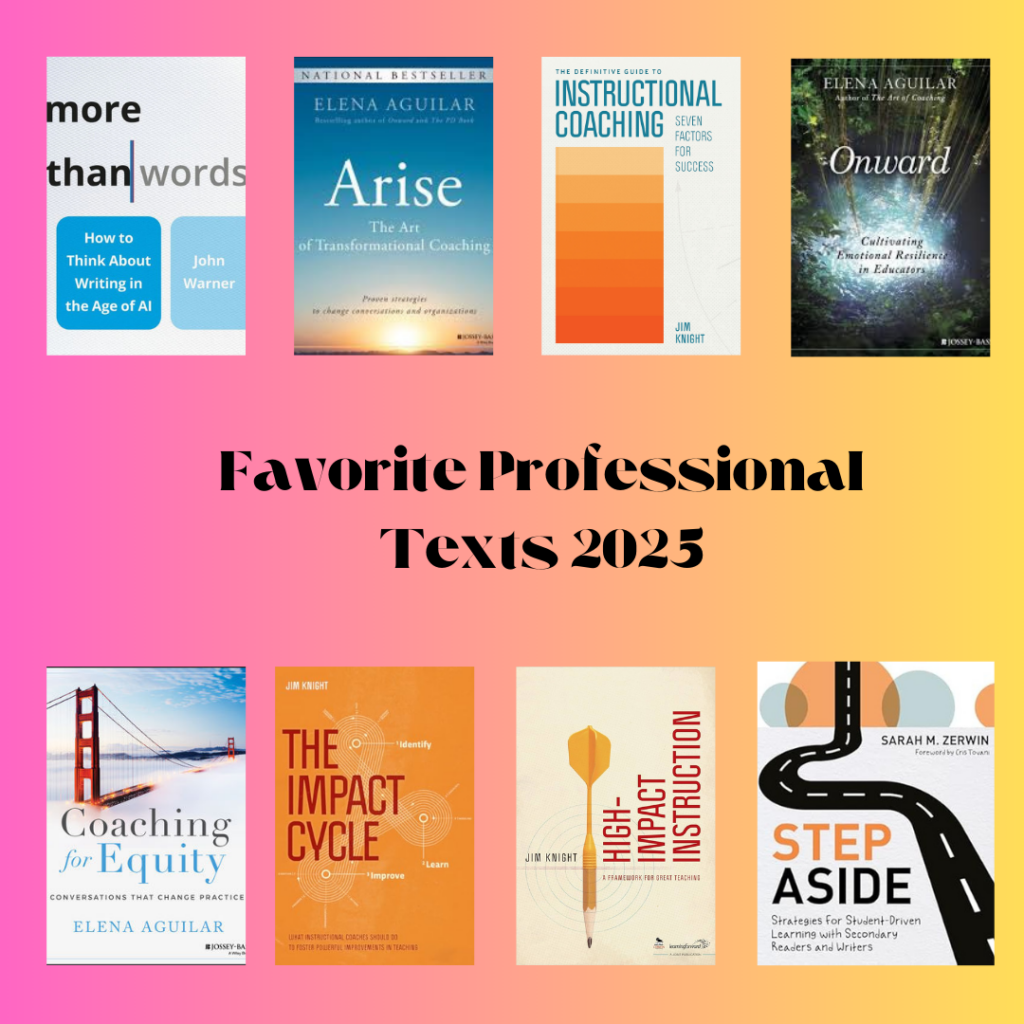
The biggest change I made was professional. By February, I knew that this would be my last year in the classroom, but I didn’t know where I could go. I knew I didn’t want to leave education, and I didn’t want to leave my school district, but I didn’t see many options. Then my district created Instructional Coaching positions. I called a former colleague who became an Instructional Coach, and she sold me on applying for the position. (I had no idea that she does consulting for Jim Knight’s Instructional Coaching Group and would eventually become our trainer.) I gave the interview process my all and was offered the position of ELA Instructional Coach! I love the job, and I adore my new colleagues, but it has been a difficult transition to say the least.

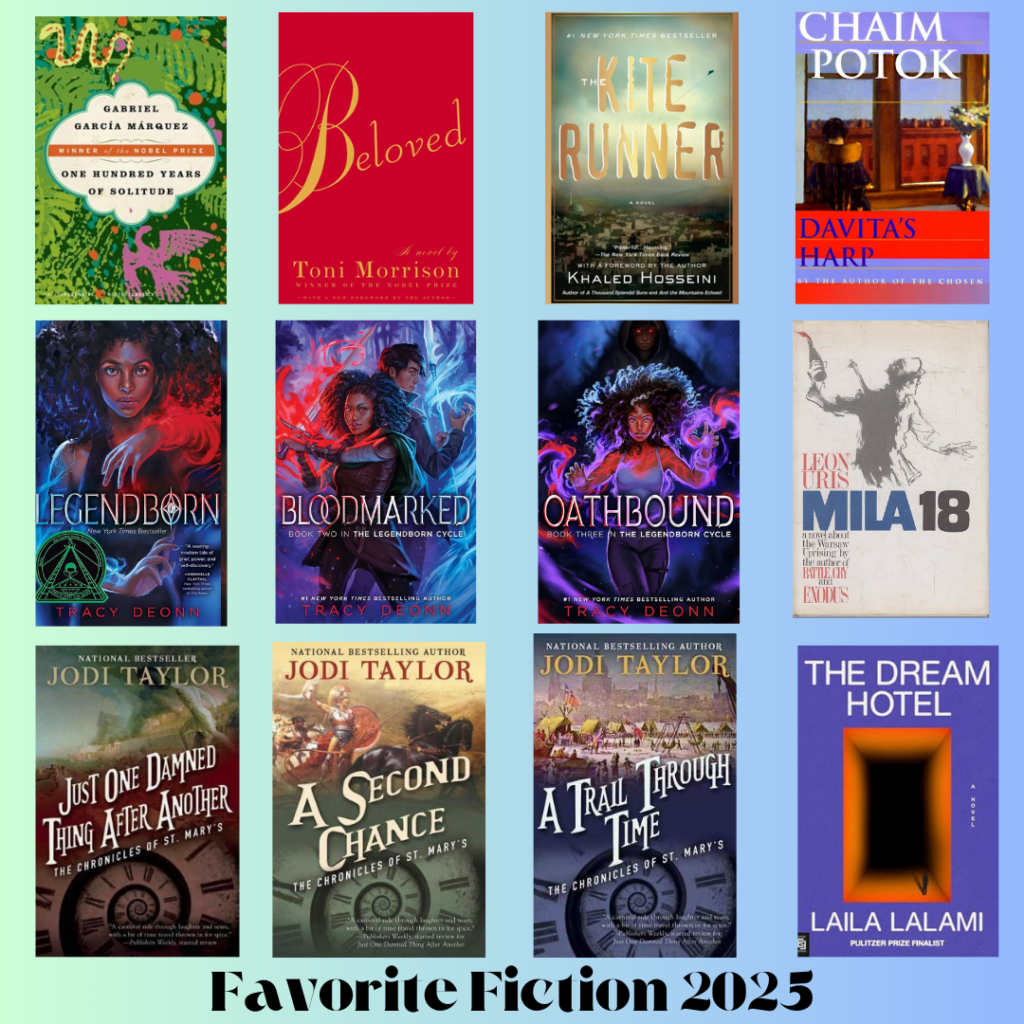
Which brings me to my fiction favorites. Most of these are rereads due to teacher book chats (Beloved), classroom teaching (The Kite Runner), and new releases (The Legendborn Cycle). In November, I decided that I needed to reread the St. Mary’s Chronicles (for the fourth time) because I was craving something familiar. This made much more sense after seeing a post online about people in middle age feeling angsty when old traditions are no longer possible and there aren’t new traditions to replace them. When I saw that, something clicked. Even though I love my new job and I have no regrets, I spent twenty-five years (almost my entire adult life) as a high school English teacher and it has completely destabilized my life. I’ve been struggling to adjust. I’ll settle in eventually, but it’s going to take some time. I need to focus on building new traditions to replace the old.

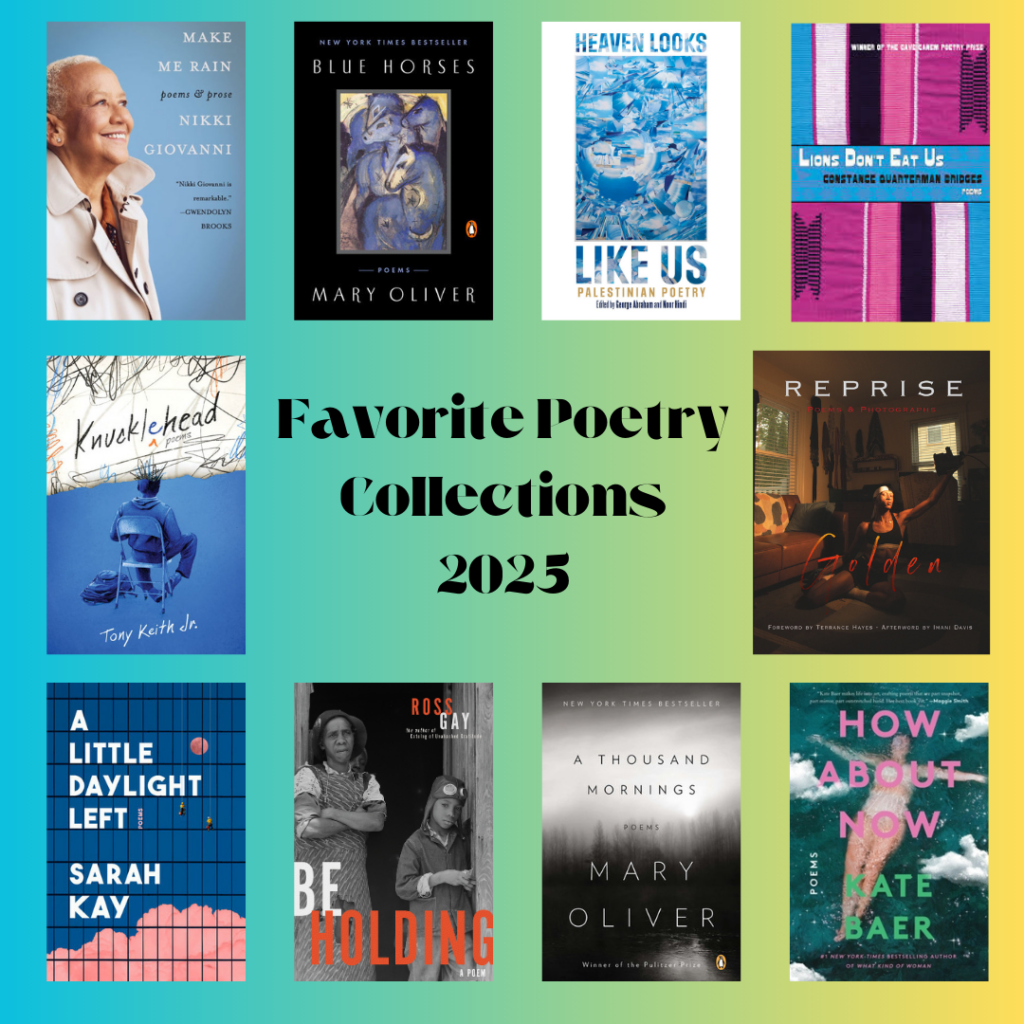
Thanks to The Sealey Challenge, I read a lot of great poetry this year. Reading Nikki Giovanni was bittersweet. She’s always been one of my favorite poets, and I don’t think I’ll ever get over her death.

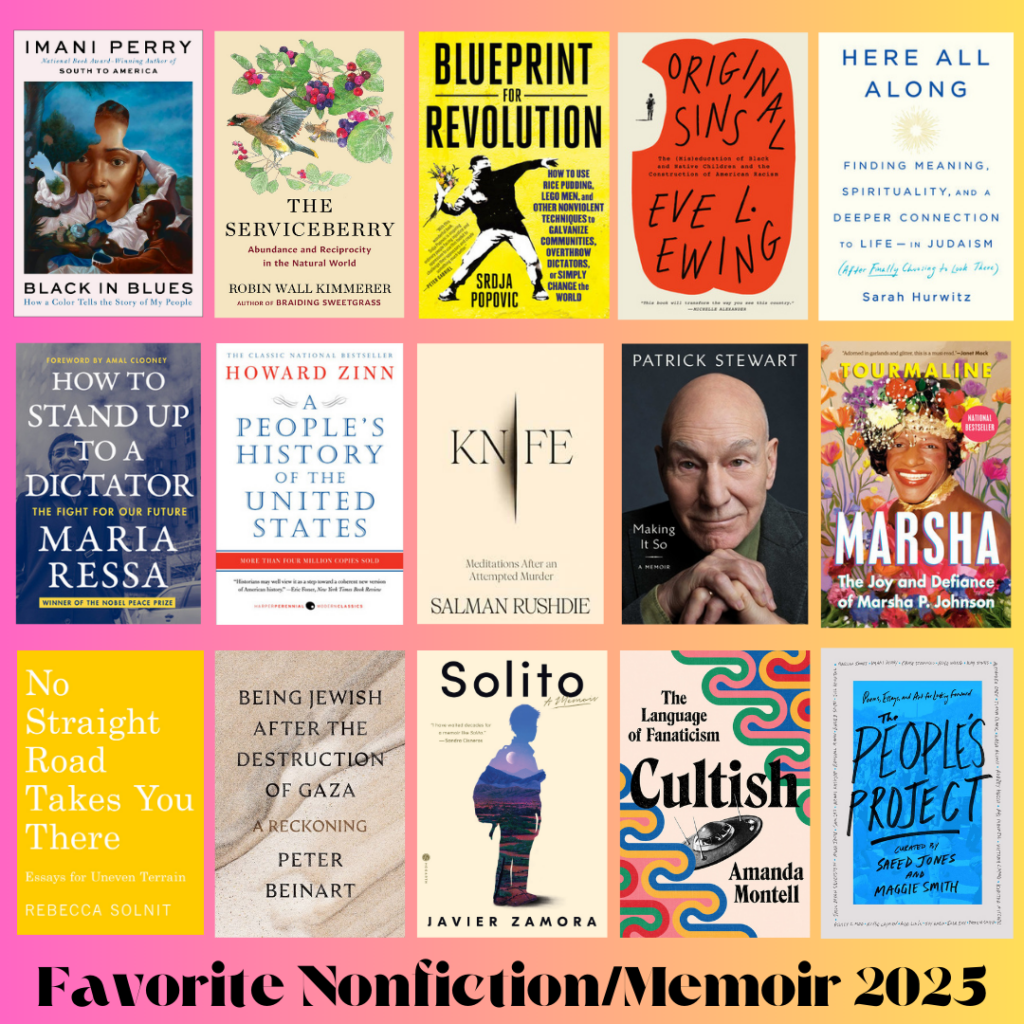
It was difficult to narrow down my nonfiction list because I gave twenty-two books five stars. Since I spent time reading about similar subjects, I selected the best from each topic. 

I didn’t complete a single reading challenge, and my chapter a day plan fizzled out, but I’m not unhappy with my reading life this year. I’m learning what does and doesn’t work for me at this stage in my life, and I’ve joined some new book clubs to motivate me and push me to read out of my comfort zone. My reading plan for 2026 is to slow down, start reading through my nonfiction shelves, and not fall behind on writing reviews for the ARCs I receive. 

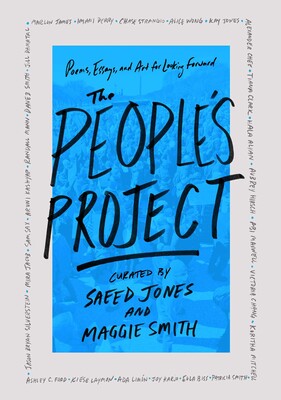
Book Review: The People’s Project: Poems, Essays, and Art for Looking Forward curated by Saeed Jones and Maggie Smith

2025 has been rough, and I wanted my final book to be one that would put me in the right mindset as I enter 2026. 

The People’s Project: Poems, Essays, and Art for Looking Forward curated by Saeed Jones and Maggie Smith (two of my favorite writers) “is a community as a book.” The voices it captures show how to persevere, show up for each other, and find joy even in the darkest times. Maggie Smith, in “My Own Project 2025,” reminds us that the future hasn’t been written yet, and we hold the pen: “Together we are living our way into the record. We are writing the story every day, all of us, and we have the power to change it.” In “An Education,” Eula Biss looks back to Vichy France and reminds us that “[t]he resistance wasn’t singular or centralized. It wasn’t a unified left–it was a collection of resistances . . . . These resistances didn’t share the same mission, or the same motives, but they served the same cause.”  She assures us that showing up now looks different for everyone and that we all have a role to play. We don’t always have to agree, but we need to focus on fighting for liberation and justice. In the poem, “Time of War,” Danez Smith writes:

so left to chaos

i become the rain

and find my center

reroute the storm

to my will. 

A strong reminder to focus on what we can control and never give into despair, because as Alexander Chee writes, “Let’s all stay alive and celebrate on the other side.”

By the end of this collection, I felt ready for whatever may come, and was reminded that I need to focus on strength and finding joy. I highly recommend this collection for anyone who needs some fortification, beauty, and hope as they usher in the new year.

Thank you to NetGalley for the ARC.

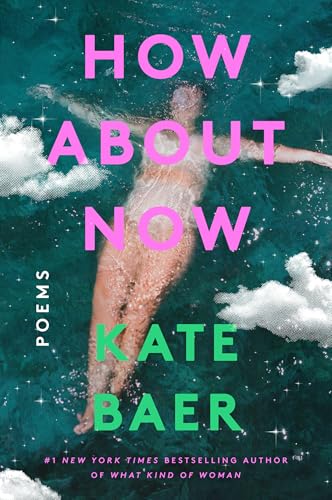
Book Review: How About Now by Kate Baer

In her latest collection, How About Now, Kate Baer confronts the tension she faces as she grapples with middle age. While the poems in this collection are deeply personal and often showcase raw vulnerability, they mirror what many women face during this stage of life (including me). Baer captures the reality of navigating relationships with family, friends, and oneself highlighting the need to step back and see the bigger picture when times are tense, while basking in the comfort of and taking joy in those relationships in times of need or peace. She also stresses the importance of appreciating each moment, and in “Meanwhile” calls on us (in a snarky way) to put down our phones. (I felt attacked.)

Ultimately, How About Now reads like a reflection (or maybe a memoir in poems) on the process of living. We are a product of our pasts, but that does not need to define us. We can let go of the distractions, focus on loving ourselves, our environment, and the people around us. The collection begins by stating, “The problem is the new life costs you the old one” and the rest of the collection shows that change, growth, and love are worth it. As Baer states in the acknowledgements, “Finally, to anyone holding this collection in your hands, wondering if there’s enough time for you: I wrote this with you in mind. You’re still here. It’s not too late. How about now?”

This is the energy I’m bringing with me into the new year.

Bookshelf Challenge COMPLETED!!!

This year has been rough, and even though I’ve been reading, I haven’t had the energy or desire to post. I do want to acknowledge that I completed my goal of reading at least one book on each of my fiction/memoir bookshelves. It only took two years, which is depressing considering that I’ve read over 400 books in those two years and I only have 38 shelves. I figured this would go quickly. Why is it so hard to read books I already own?

Here’s the stack representing the final shelves. It’s a little blurry, but I feel like that’s appropriate considering how messy my life has been lately. (More on that later. It’s not bad.)

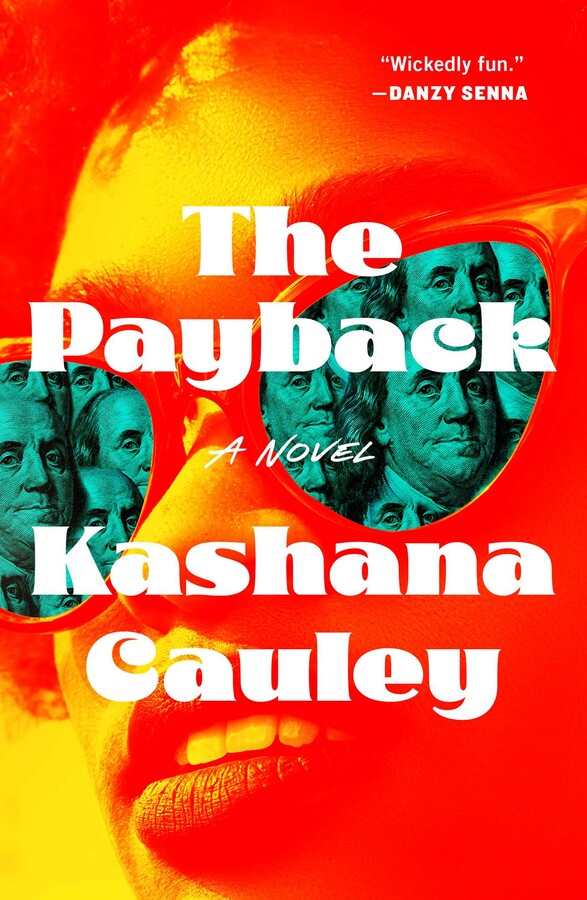
Book Review: The Payback by Kashana Cauley

One of my first thoughts when the extremely brutal Debt Police make an appearance in The Payback was, “I hope no one in power reads this and gets ideas,” because like a lot of books with dystopian elements, The Payback should not be an instruction manual. Well, unless you’re rooting for the protagonist, Jada, and her friends, Audrey and Lanae, as they come up with a scheme to erase their student debt and take down the system as a whole. The novel shows how deep the problem of debt, especially student loan debt, runs and how difficult it can be to get out from under it. The Debt Police are a violent representation of how much debt can brutalize you and keep you down, adding a physical layer of demoralization, fear, and despair to Cauley’s critique of the current system, ultimately asking the question of whether we need to be paying so much for education (among other things) at all.

Cauley’s characters are well developed, entertaining, and smart, and the novel is a necessary critique of many elements of society. I highly recommend it!

Thank you to NetGalley for the ARC!

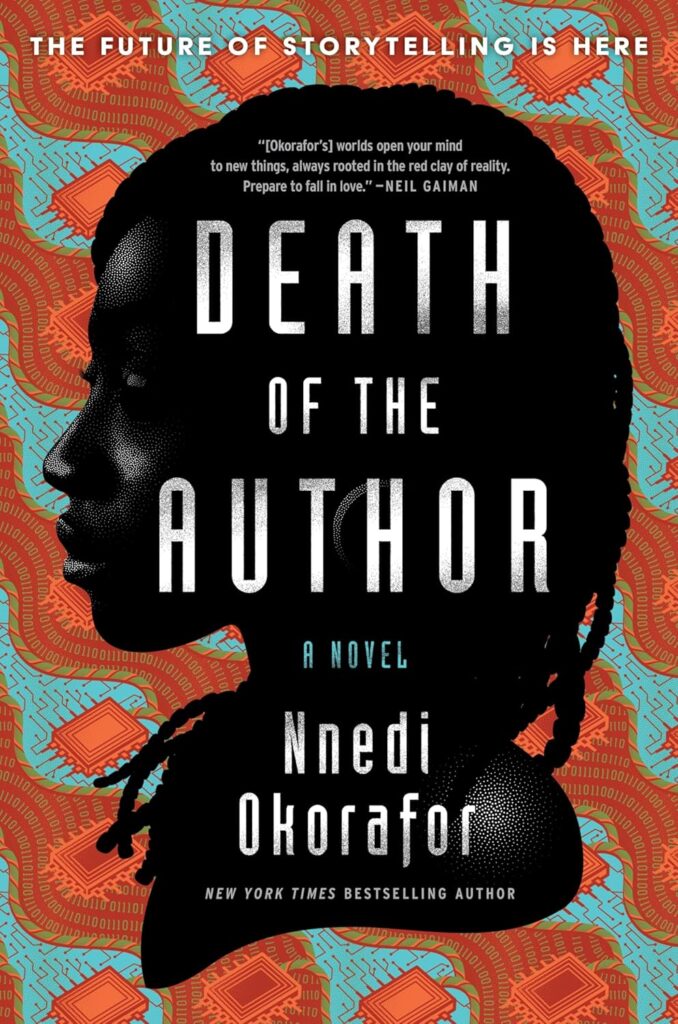
Book Review: The Death of the Author by Nnedi Okorafor

I feel like I should read this a few more times before writing a review, because even though this is a fast and engaging read, there’s immense depth to this novel that showcases Okorafor’s masterful skill as a writer. The title evokes Roland Barthes’ essay in which he argues that literary critics should avoid using the biography of the author to aid in finding meaning in a text. Instead, the reader’s own analysis should be centered. Okorafor brilliantly plays with this idea through Zelu’s story as she watches her novel morph into something she never intended as it is adapted for the screen. And then there’s the tendency to look to Okorafor’s life as an inspiration for the novel. What do we make of that? 

The Death of the Author is a masterful work on every level, and I cannot recommend it enough.

Thank you to NetGalley for the ARC!

Book Review: The Dream Hotel by Laila Lalami

In The Dream Hotel, Laila Lalami envisions a dystopian future where, after a devastating mass shooting, dreams are monitored and Americans are given a risk score in order to prevent future violence. The main character, Sara, is detained due to postpartum dreams that indicate to the Risk Assessment Agency that her husband may be in danger. What is originally to be a twenty-one day period of observation turns into a lengthy ordeal that raises many questions relevant to what we’re seeing today with technological advances and authoritarian legislation. 

The Dream Hotel seems like a cautionary tale warning us of what could happen if we open ourselves up to more surveillance. If we think we’re among the “good people” who would never pose any risks or be targeted. If we place too much trust in technology (especially AI) to solve our problems. 

This is a disturbing but necessary read because Sara’s response to her detainment, her observations of the world around her, and her work toward freedom offers hope that there is always a way out. 

Thank you to NetGalley for the ARC!

Book Review: More Than Words: How to Think About Writing in the Age of AI by John Warner

John Warner’s views on writing have been indispensable to me as a high school English teacher, and his exploration of what AI means for how we approach writing instruction is exactly what English teachers need in this moment. In More Than Words: How to Think About Writing in the Age of AI, Warner continues his call for educators to create writing assignments that are authentic and engaging (the type of writing that AI can’t produce). More importantly, he explains how AI works and the ethical implications of AI use, which are vital to understanding its impact on the classroom. Ultimately, Warner shows the importance of writing to thinking and feeling and clearly identifies what is lost when that is outsourced to AI. More than Words is about so much more than writing instruction; it’s an argument for writing’s role in communication and connection, which is what makes teaching and learning meaningful.

Warner’s framework for thinking about AI, “Resist, Renew, Explore,” acknowledges that we cannot ignore AI’s presence or the impact it will likely have on our lives, and offers guidance for how to approach it.  Since there’s a great danger in “leaping into an unknown without proper consideration,” there are times when we should clearly resist AI, but there are also times when we should explore what’s possible. However, Warner is clear that in our exploration, we need to be cautious and aware of potential harm. Should we be exposing students to AI chatbots in the classroom? What exactly are we teaching students by having them use AI? Does use of AI aid in skill development or hinder it? Shouldn’t we be arguing for more time to do our jobs rather than getting excited about being able to outsource important tasks like grading and leaving feedback to AI? These are all questions I’ve raised, and I’m grateful that John Warner addresses them in More Than Words

Teachers must contend with AI. There’s no way around it, but we need to have more nuanced conversations about the role it should play in our classrooms. More Than Words brings up many strategies to navigate AI use and is a must for any educator. 

Book Review: Black in Blues: How a Color Tells the Story of My People by Imani Perry

I vividly remember how captivated I was the first time I read Imani Perry’s writing. I picked up a copy of Breathe: A Letter to My Sons to read before she came to speak at our local book festival. I must have read the first page at least ten times because I couldn’t get enough of how she commanded language and ideas. I felt the same way while reading Black in Blues: How a Color Tells the Story of My People, which is both a meditation on the significance of the color blue to Black life and culture and a journey through history. I’ve often wondered why we typically study various histories in isolation instead of zooming out to see a global perspective, and Perry’s book shows exactly why it’s much more interesting and beneficial to look at history holistically. I was fascinated by how often the color blue figured prominently in Black history from early indigo trading to Blues music. I can only imagine the meticulous research that went into a project like this, and how it must have felt to travel through so many stories of both joy and heartbreak. As Perry states, “There is no single Black essence. There is no fundamental way of being Black,” and she shows that using various shades and iterations of the color blue. 

To me, the importance of this book is captured in one of the final chapters, “Seeing the Seventh Son,” where Perry writes about the importance of haunting the past: “We haunt the past to refuse to let it lie comfortably as it was. We give back to them [the ancestors] in return for the inheritances they have bestowed upon us.” As I continue to see teaching history and literature under attack and stories of marginalized groups banned or otherwise silenced, haunting the past is increasingly important for us all. Black in Blues shows the importance of beauty, art, music, and joy in the face of oppression, because that is how humanity survives. Perry writes that her goal was to “attend to what these artists teach, in sound and color, about the human condition,” and she does just that. She goes on to write that “[c]onjurers survive conquerors.” Though it is painful and disheartening, the current political climate in the United States is not new or unique. Black in Blues tells a story of Blackness through its link to the color blue that highlights both hope and pain and details a complex history that is vital to understanding the world today.

Thank you to NetGalley and Harper Collins/Ecco for the ARC.

Shelf #26 Complete (FINALLY), On to Shelf #27

This project completely derailed, and I didn’t start Who Fears Death until January 1st. Like I wrote earlier, 2024 never gave me a break, and I’ll own that I didn’t manage the stress well. I’m working on setting things right, because 2025 has been giving me signs that I need to make major changes. It’s scary, but exciting.

Who Fears Death is brutal and brilliant. There’s so much going on in this novel, and since I treat my bookshelf exploration as reading for fun, I didn’t take notes to do a true review. Nnedi Okorafor’s worldbuilding is brilliant, and I appreciate how she distinguishes her work as Africanfuturism. I learn so much from reading her writing.

Now for shelf #27!

I’ll probably read something by Chaim Potok or The Shipping News depending on my mood and when I have time. I went a little overboard with requesting ARCs, and I have some book club deadlines. I’m definitely more motivated to read when I have due dates or reviews to write in advance of a book’s publication. The downside is that it cuts into my goal of reading the books I already own. I need to figure out how to stop time!

Books I’ve read:

  • George Orwell 1984
  • Amos Oz To Know a Woman
  • Sheena Patel I’m a Fan
  • Alan Paton Cry, the Beloved Country
  • Alan Paton Tales from a Troubled Land
  • David Payne Ruin Creek
  • Iain Pears The Dream of Scipio
  • Nichole Perkins Sometimes I Trip on How Happy We Could Be
  • Torrey Peters Detransition, Baby
  • Harold Pinter Homecoming
  • Regina Porter The Rich People Have Gone Away
  • Chaim Potok The Chosen
  • Chaim Potok The Promise